Quality2 min read
How to Store Makhana for a Full 12-Month Shelf Life
Makhana rarely spoils. It goes soft — and soft makhana is a rejected consignment. Almost every failure traces back to one variable.
Read article
Quality4 min read
Understand what 5 Suta Makhana means, how makhana sizing and grading work, and what makes this grade different from other varieties. Explore its size, quality, uses, and importance when choosing makhana for everyday consumption or bulk purchasing.

Choosing the right makhana grade when buying for retail, roasting, or bulk supply matters a lot. Different grades do vary in size, appearance and suitability for different use cases. 5 Suta makhana is a commonly used option for retail snacks. Buyers should also consider quality, moisture, and price.
At Girinoora, we supply 5 Sutta Classic Premium Makhana for retail, bulk, and export buyers. This guide will explain to you the size, quality standards, pricing factors, and common uses.
What Does Suta Mean in the Makhana Grading System?
Sorting popped makhana by size is known as suta, and a larger number means a larger pop. After the seeds are roasted and popped, machines sift them by diameter. That is what lets a buyer order the same size again next season and receive a pack with the same roast and appearance as the previous order.
Makhana is usually available in three grades based on pop size, with 5 Suta being the middle grade. Each grade has different characteristics and uses.
4 Suta Makhana: This grade generally has a pop size of 13 to 15 mm. It is commonly used for commercial and industrial processing.
5 Suta Makhana: With a pop size of 16 to 19 mm, 5 Suta is considered the middle grade. It is commonly preferred for retail snacking and roasting.
6+ Suta Makhana: This grade has a pop size of 20 mm and above. It is generally used for premium packaging and top-tier export markets.
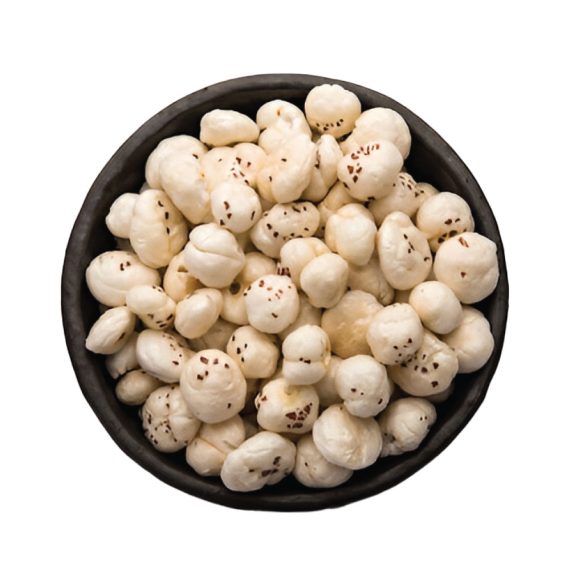
Good 5 suta makhana should be well-rounded and bright white, light in the hand, clean and crunchy, with a neutral flavour. Ask the supplier about any pops that look yellowish, flat or spotted. A compact size band means a handful from a good lot will look nearly identical.
There are four deciding factors in the quality of 5 suta makhana: size consistency, colour, moisture and clean sorting.
Size Consistency
Almost every pop in a lot should fall inside the grade's range. Bags that mix smaller and larger pops roast unevenly and look untidy once packed.
Colour and Black Spots
Look for bright white pops with very few black spots. Dark specks and yellowing lower the look of a pack, even when the taste is fine.
Moisture Level
Moisture content less than 10% gives the pops satisfactory storage and shipping qualities. Girinoora packs its makhana below that level, with a shelf life of 12 months from the date of packing.
Clean Sorting
It is advisable to remove husk, grit and broken seed by hand before packing. A lot with many broken pieces costs more in waste, since broken pops cannot be sold as the grade.
Usually, the 5 suta makhana price is higher than 4 suta and lower than 6+ suta, because the price increases as the pop size increases. The exact figure varies with the harvest season, the quality of the lot, the packing type and the quantity ordered.
To compare quotes accurately, ask every supplier for a per-kilo price on the same grade, moisture content and packing method, and say whether it is FOB or CIF. If a price is significantly lower than the rest, it may indicate mixed grades or high moisture.
Why Choose Girinoora's 5 Sutta Classic Premium Makhana
Girinoora's 5 Sutta Classic Premium is an international benchmark grade. Each lot is sorted by hand, then by machine, and each pack has an individual lot code that identifies the sourcing cluster and processing date.
Orders are shipped worldwide in nitrogen-flushed vacuum packs, and Girinoora can supply retail, bulk, private-label and export buyers. For a sample or a quote, reach out to the Girinoora export team.
Frequently Asked Questions
6+ suta makhana pops are 20 mm and above in size, and hence a pack of them will have fewer pops than a pack of 5 suta. Larger pops also affect the way a pack looks on the shelf, so select the grade based on what you want the pack to look like.
May I use a combination of grades in the same pack?
It is fine to mix them if you have to, but it is better to keep makhana grades in separate groups. Mixed sizes roast at different times, so some pops may be soft, and some may burn.
How can I check the size of 5 suta makhana at home?
Place a couple of pops alongside a ruler and measure the widest point. The majority should fall within the range of 16 to 19 mm, with a few outliers being normal.
Before ordering 5 suta makhana, what should I ask the supplier?
Request the size specification, moisture content information, packing information and a sample of the actual lot. If you are sending goods abroad, find out what documents are provided with the goods.
Updated 4 Nov 2026
Keep reading
Quality2 min read
Makhana rarely spoils. It goes soft — and soft makhana is a rejected consignment. Almost every failure traces back to one variable.
Read article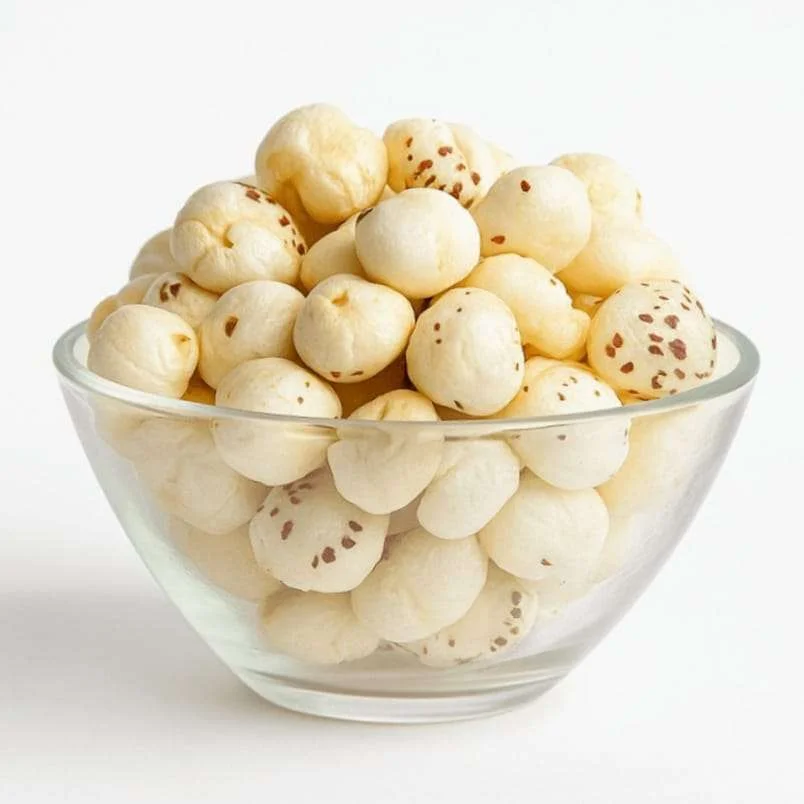
Quality2 min read
Get in touch
Share your grade, quantity and destination. We will come back with pricing, packing options and lead time — usually within one working day.
Suta is the trade's sizing language, and it is the single most misunderstood term in a makhana quotation. Here is what each grade means and which one your product actually needs.
Buying Guides2 min read
Most bulk makhana disputes are not about quality. They are about a specification that was never written down. Here is what to pin before you place an order.
Read article